
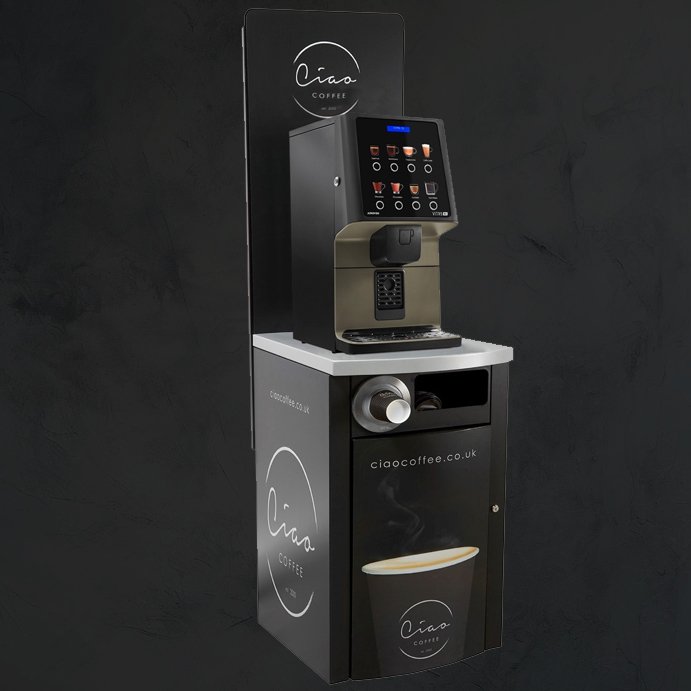
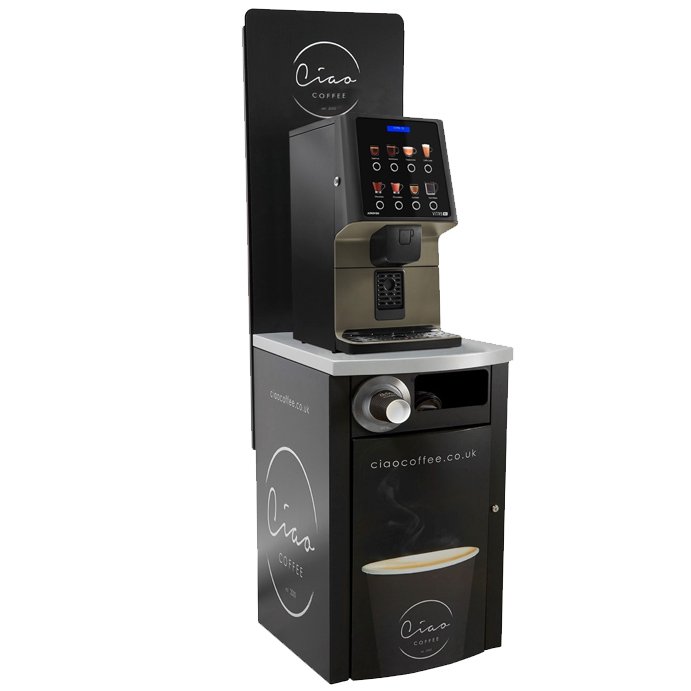
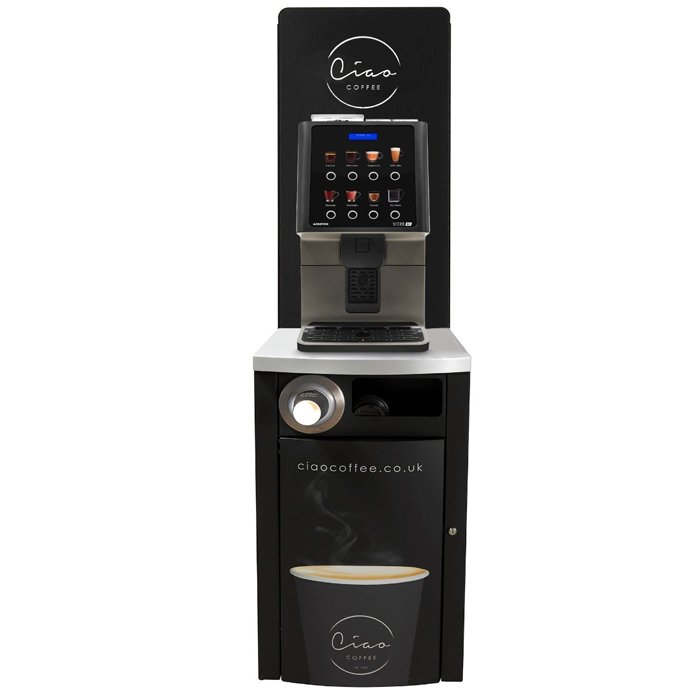
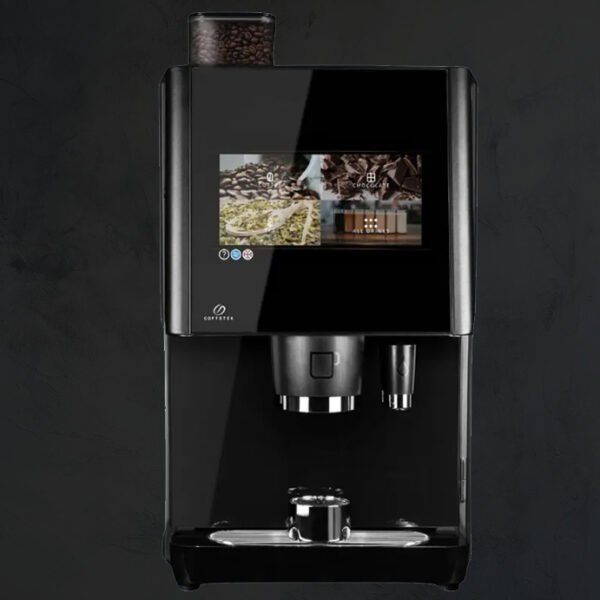
Space is usually the deciding factor for a first coffee offer, and the Ciao Coffee to Go Station VS1 is scaled for exactly that situation. It houses the entry-level VS1 bean to cup machine in a purpose-made serving cabinet, so a shop, reception or staffroom gains a proper coffee point without surrendering a long stretch of counter to make it work. Everything a customer touches sits on the front face, which keeps the queue in one place.
What comes out of it, and what sits beside it
Beans are ground fresh for every order and extracted under pressure, which is what separates a genuine espresso base from a powdered instant. From that base the machine builds the familiar range of white and black coffees, espresso, americano, cappuccino and latte among them, plus hot chocolate, each following a stored recipe. Selection is single-touch and designed for unattended customer use, so customers need no explanation and staff spend no time coaching anyone through the menu. Around the machine, the cabinet gives a dedicated area for cups, lids, sugars, stirrers and napkins in a compact footprint, with the sort of tidy front-of-house appearance that suits a customer-facing position. Volume expectations are modest by design: this is for a site building a coffee habit rather than one serving a constant rush.
A first machine, not a last one
Independent shops, small offices, salons, garages and community venues tend to be the best match, where a modest but steady flow of drinks makes a machine worthwhile and a staffed counter does not. The VS1 is an entry point, and the sensible way to buy it is with that in mind. It proves whether your customers will pay for coffee, at a level of commitment that does not hurt if the answer turns out to be no. Plenty of sites find the answer is yes and outgrow it, which is a good problem to have and a quick lesson learned. The mistake to avoid is buying at this level while privately expecting the volumes of a busy forecourt, so be deliberate about matching the machine to the cups you will actually serve each day rather than to the trade you hope for. As a first machine it is a low-risk one, not least because two years of warranty come with it.
Fitting it in, and keeping it fed
Siting a compact station is easier than siting a full counter, but the same rules apply in miniature. It needs a level floor, a socket within reach and enough clear space in front that somebody can stand and wait without being in the way of a door or a desk. Put it where it can be seen, because a coffee point tucked out of sight in a back corner will not build the habit you are paying for, and leave yourself access to top up beans and empty waste without dragging the cabinet out. Beyond a socket and a stretch of clear floor, the installation itself is undramatic. The daily work is just as light: top up beans and ingredients, empty the grounds and waste water, then run the cleaning programme at the end of the day, with servicing scheduled around normal trading rather than disrupting it. In a small team the practical risk is not that the work is hard but that it belongs to nobody, so put the end-of-day cycle into the closing routine alongside locking up and it will not be missed. Keeping cleaning consumables on the shelf removes the other common excuse.
The limits of a small station
If more than a handful of people will want a coffee at the same moment, or if takeaway coffee is meant to be a real revenue line rather than a courtesy, step up to a larger station. If your drinkers are mostly milk-based and particular about it, look at the machines with broader milk handling. The VS1 earns its place where the volume is genuinely modest and the alternative is a kettle, and the larger cabinets across the coffee to go stations are the natural next step up.
Reviews
There are no reviews yet.